
6 June 2019 – After going through the Troy lock, we come to the junction at Waterford for the Erie and Champlain Canals.
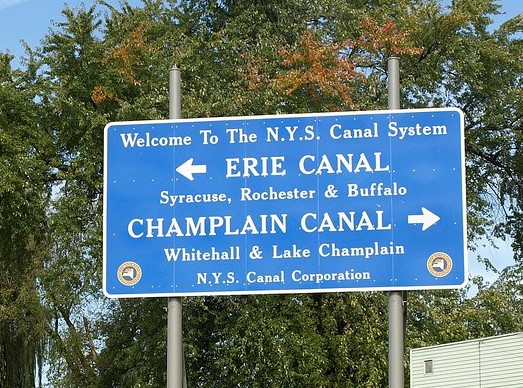
The spring opening of the canal to Lake Champlain had been delayed for weeks, and there had been a large backlog of boats hoping to head that way. They had docked at Waterford, and even up the Erie Canal at every free tie-up they could find.
We had hoped to use the free dockage there, ourselves, in order to go to the Welcome Center, and take advantage of some of the amenties before heading into the Erie Canal. The announcement had come from the canal officials on Wednesday that they were opening the first five locks, and we figured that all the boats poised at Waterford would vacate their berths and leave us with space.
Wishful thinking. We cruise up to find it totally packed still, with little option but to bypass it and head into the first set of locks. We motored back out into the river for a few minutes, and got all our fenders deployed to protect the sides of the boat from the rough and dirty concrete walls of the lock chamber. Then it was GO-time.
The first five locks of the system comprise a ‘flight’ that have to be taken one right after the other, with no stopping in between. When built in 1907 the 5 locks that comprise the Waterford Flight of Locks raised watercraft 165 feet in just over a mile. This is the greatest lift in the shortest distance on any canal system in the world. It still is today. These five locks are necessary to navigate around the Cohoes Falls.
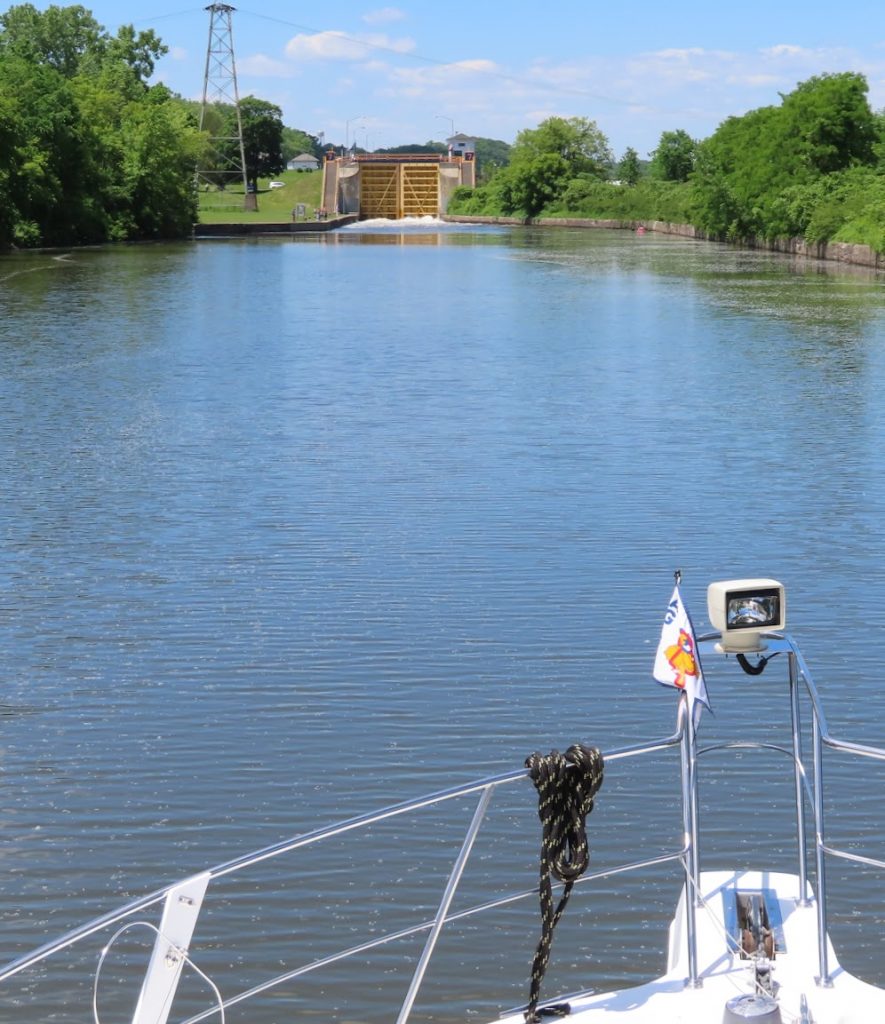
The locking process wound up being much more stressful and physically demanding than we had anticipated. First, we had to get safely into the lock chamber; for some locks, there were strong currents and eddies where the water coming over the falls adjacent to the lock would swirl into the area where we were waiting to enter; this could be aggravated if the lock was needing to be lowered for us to enter. When that is the case, all the water in the chamber has to be released, and we can see a big white, frothy churn of water at the bottom of the lock gates.
When we enter the locks, we have to pull alongside a wall, and secure the boat. Well, secure is kind of an overstatement. In the first few locks, there are heavy plastic coated cables in a recess in the lock wall, around which we can loop one of our lines, to keep the boat from swinging. In others, there are simply heavy (weighted at the bottom) lines hanging from the top of the chamber, that are wet and slimy from living much of their life in the water. We’d each grab a line, and hang on for dear life. You might think that the boat would simply rise up, resting benignly on the water’s surface.
Uh, no. As the lock chamber fills with thousands of gallons of water in a few short minutes, the boat lurches forward, backward, sometimes pinched against the wall so the fenders are squeezed as they scrub up the concrete walls, and other times wanting to pull us off as it drifts toward the opposite wall. Thankfully, we locked alone in every lock on the flight of five, and didn’t have to worry about any other boat(s) as we worked our way through the steep part of the learning curve.
Sorry that there aren’t more pictures of this section, but we were a bit …let’s just say…preoccupied. (We do have a video – check back to see if I am able to upload it)
Since we had come all the way from our anchorage early this morning, and hadn’t really intended to attack the locks today, we were very happy to find a marina a short way up the river to tie up and consider the events of the day.